If you haven’t read our guide to the official starting point of Route 66 in Chicago, be sure to check it out before continuing the journey.Who Were the First Travelers on Route 66? The Untold Stories of the Mother Road
Long before Route 66 became famous for neon signs, classic diners, and roadside attractions, it belonged to the people who traveled it first.
These weren’t tourists searching for Instagram-worthy stops or families on summer vacations. They were workers, farmers, dreamers, and adventurers looking for something better over the horizon.
When Route 66 was officially established in 1926, America was changing rapidly. Automobiles were becoming more common, roads were improving, and people were beginning to see travel in an entirely new way. The Mother Road connected communities across eight states and offered something many Americans had never experienced before: the freedom to go wherever the road led.
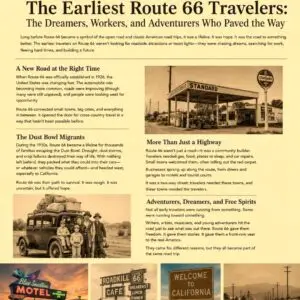
The iconic beginning of Route 66 in Chicago marks the eastern starting point of America’s most famous highway and the beginning of countless adventures.
A New Road for a New America
In the 1920s, cross-country travel was still an adventure.
Many roads were unpaved, gas stations were few and far between, and reliable maps could be difficult to find. Yet Route 66 quickly became one of the most important highways in the nation because it connected major cities with countless small towns in between.
For many early travelers, the road wasn’t about sightseeing. It was about opportunity.
Salesmen drove long distances to visit customers. Truck drivers transported goods across state lines. Workers followed rumors of jobs in growing cities. Families packed everything they owned into their vehicles and headed west in search of a brighter future.
Route 66 became more than a highway. It became a pathway to possibility.
The Dust Bowl Years
Perhaps no group is more closely associated with the early history of Route 66 than the Dust Bowl migrants of the 1930s.
Years of drought, crop failures, and devastating dust storms forced thousands of farming families to leave their homes across Oklahoma, Texas, Kansas, and surrounding states. With little more than hope and determination, they loaded their belongings into aging cars and trucks and headed west toward California.
For these families, Route 66 was not a vacation route.
It was a lifeline.
The journey was often difficult. Vehicles broke down. Money was scarce. Many families slept in their cars or camped beside the road. Yet they continued westward because the road offered something precious: the chance to start over.
Those travelers helped define Route 66 as the “Road of Hope,” a reputation that remains part of its legacy today.
Truckers and Road Warriors
Long before the interstate highway system transformed American transportation, truck drivers depended on Route 66.
The highway connected farms, factories, and communities across the country. Delivering goods was not always easy. Drivers faced rough road conditions, unpredictable weather, and long hours behind the wheel.
Yet Route 66 became the backbone of early commerce.
Small service stations, repair shops, restaurants, and roadside businesses appeared along the route to serve these hardworking travelers. Many of the iconic Route 66 establishments we celebrate today owe their existence to the steady flow of truck traffic that once passed through town.
Adventurers Seeking the Unknown
Not everyone traveling Route 66 was escaping hardship.
Some were chasing adventure.
Writers, photographers, artists, and curious travelers were drawn to the open road. Route 66 offered a front-row seat to America’s changing landscape, from bustling cities and farming communities to deserts, mountains, and coastal towns.
For these travelers, the journey itself became the destination.
They stopped in places they had never heard of, met people from different backgrounds, and discovered stories that could never be found in guidebooks.
Many of the legends and folklore surrounding Route 66 were born from these early adventures.
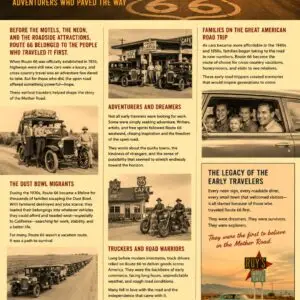
An illustrated look at the workers, migrants, truckers, and adventurers who traveled Route 66 during its earliest years and helped build the legend of the Mother Road.
Families Discover the American Road Trip
By the 1940s and 1950s, Route 66 had become America’s road trip highway.
Families packed their cars, loaded their suitcases, and set off to explore the country. Motels, diners, drive-ins, and tourist attractions began appearing along the route to welcome these new travelers.
For many Americans, their first long-distance vacation happened on Route 66.
Children watched the landscape change outside the window while parents followed maps and road signs westward. The memories created during these trips helped cement Route 66’s place in American culture.
The Mother Road had evolved from a practical transportation route into a symbol of freedom and adventure.
The Legacy of the First Travelers
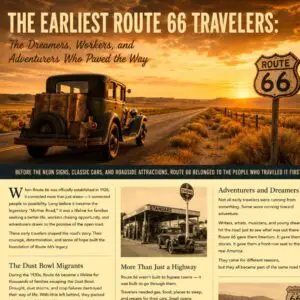
A vintage automobile travels along Route 66, representing the early dreamers, workers, and adventurers who helped establish the Mother Road as one of America’s most iconic highways.
Every famous road has a story, but Route 66 is unique because its story belongs to so many different people.
It belongs to the farmers searching for a second chance.
It belongs to the truckers who kept goods moving across America.
It belongs to the dreamers who wanted to see what waited beyond the next horizon.
And it belongs to the families who discovered the joy of the American road trip.
Without those early travelers, Route 66 would simply be another highway on a map.
Instead, it became a legend.
Today, millions of people still follow the Mother Road, tracing the path of those who traveled it first. Every mile carries their stories, their struggles, and their hopes for something better waiting just around the bend.
The road may be historic now, but its spirit was created by the people who believed in it from the very beginning.

Author: Route 66 Finds
Route 66 Finds is your guide to the greatest road trip in America. We uncover the hidden gems, historic landmarks, natural wonders, and unforgettable experiences along the Mother Road — from Chicago to Santa Monica. Discover. Explore. Remember.
1 Comment