Every great journey has a starting point.
For Route 66, that beginning wasn’t in the deserts of Arizona, the neon-lit motels of New Mexico, or the beaches of California. It started in the heart of Chicago, where busy city streets gave way to a dream that would forever change American travel.
Today, millions of people know Route 66 as the “Mother Road,” a ribbon of pavement filled with nostalgia, classic diners, vintage gas stations, and unforgettable roadside attractions. But long before it became a symbol of freedom and adventure, it was simply an idea—a way to connect communities across America.
That idea became reality on November 11, 1926, when U.S. Route 66 was officially designated as part of the new national highway system. Stretching roughly 2,400 miles from Chicago to California, it linked small towns and major cities through eight states, creating one of the most famous roads in history.
Chicago: The Birthplace of Route 66
When Route 66 was created, Chicago was the perfect starting point.
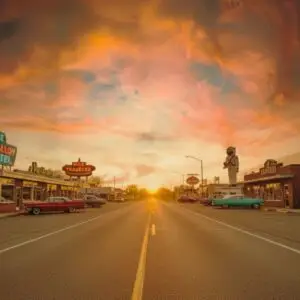
A scenic stretch of Route 66 captures the freedom and adventure that made the Mother Road a symbol of the American dream and cross-country travel.
The city was already one of America’s great transportation hubs. Railroads, waterways, and highways all converged there, making it a natural gateway to the western United States. Travelers heading west often passed through Chicago, and Route 66 gave them a clear path toward new opportunities, new adventures, and new lives.
The original eastern terminus was located at the intersection of Michigan Avenue and Jackson Boulevard in downtown Chicago. Standing there today, it’s difficult to imagine that this busy urban intersection marked the beginning of a road that would become a global icon. Yet from this spot, generations of travelers pointed their cars west and set off into the unknown.
More Than Just a Highway
What made Route 66 different from many roads of its era was its purpose.
Rather than bypassing communities, it connected them. The route was designed to run through the main streets of towns both large and small, bringing travelers directly into local businesses, restaurants, hotels, and service stations. For many communities, Route 66 became an economic lifeline.
As traffic increased, entire industries grew alongside the highway. Motor courts evolved into motels. Roadside cafes became destinations. Gas stations, souvenir shops, and quirky attractions competed for the attention of passing motorists. The road wasn’t simply a way to get somewhere—it became part of the experience itself.
The First Travelers
The earliest Route 66 travelers weren’t looking for Instagram-worthy roadside stops.
Many were searching for work, opportunity, or a fresh start.
During the Dust Bowl years of the 1930s, thousands of families traveled west along Route 66, hoping to build a better life in California. Their stories helped shape the road’s reputation as a pathway to hope and possibility. For countless Americans, the journey west began in Chicago and unfolded mile by mile along the Mother Road.
Over time, Route 66 evolved from a practical transportation route into a symbol of freedom. Vacationing families loaded their cars and headed west. Motorcyclists chased open horizons. Dreamers followed the road simply to see where it would take them.
Why the Beginning Still Matters
Ask most people about Route 66, and they’ll picture desert landscapes, vintage neon signs, or the famous Santa Monica Pier.
Yet the story of Route 66 begins far from those postcard images.
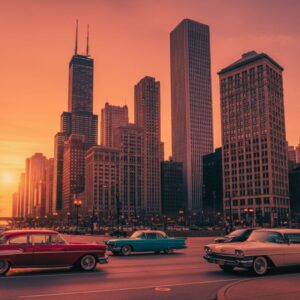
Chicago’s iconic skyline represents the city where Route 66 officially began in 1926. As one of America’s great transportation hubs, Chicago served as the gateway to the West.
It begins in Chicago, where a new highway was born during a period of tremendous change in America. The first miles of Route 66 represent the moment when cross-country travel became more accessible, when small towns gained a connection to the wider world, and when the American road trip began to take shape.
Even though Route 66 was officially removed from the U.S. Highway System in 1985, its legacy remains stronger than ever. Historic sections of the road continue to attract travelers from around the world, many of whom begin their own journey where the Mother Road first started—in Chicago.
The Road Starts Here
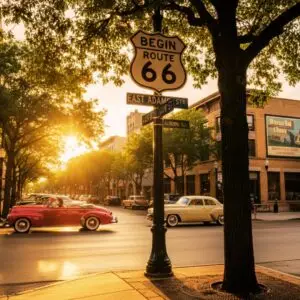
Historic Route 66 Sign in Chicago Where the Mother Road Begins
There’s something special about standing at the beginning of Route 66.
You can look west and imagine nearly 2,500 miles of history stretching toward the Pacific Ocean. You can picture the families, adventurers, truck drivers, dreamers, and explorers who traveled this same route over the last century.
Every famous road has a story.
For Route 66, that story starts on a Chicago street corner, where an ordinary intersection became the starting point of America’s most legendary highway.
And nearly 100 years later, the journey still inspires people to get behind the wheel and discover the magic of the open road.
A lot of people mistakenly use Jackson Boulevard because the original 1926 routing changed over time. Today, the official and most photographed “BEGIN Historic Route 66” sign is located at the corner of Adams Street and Michigan Avenue, directly across from Chicago’s Art Institute.
Now that we’ve explored where Route 66 began in Chicago, discover the remarkable stories of the first people who traveled the Mother Road and helped shape its legendary history.

Author: Route 66 Finds
Route 66 Finds is your guide to the greatest road trip in America. We uncover the hidden gems, historic landmarks, natural wonders, and unforgettable experiences along the Mother Road — from Chicago to Santa Monica. Discover. Explore. Remember.
2 Comments